Institutional Orderflow Pro
Checks whether volume, price position, delta, and VWAP are pointing the same way, then explains which conditions are missing. It is a futures-only confirmation tool, not a top or bottom caller.
Technical scope
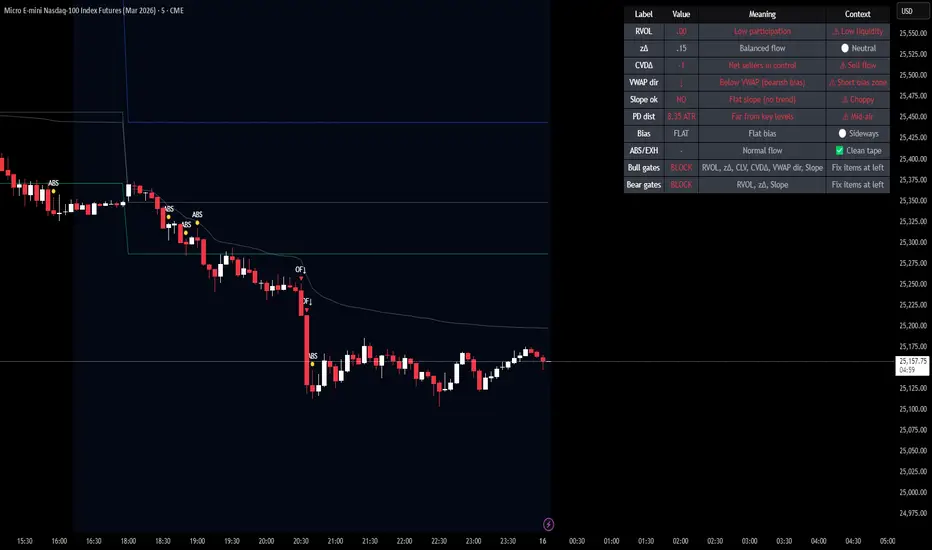
A bar-by-bar order-flow read that fires a signal only when six independent measurements agree: relative volume, the delta z-score, cumulative-delta direction, close-in-range, VWAP side and slope, and proximity to prior-day levels. Absorption and exhaustion prints run alongside. Its defining feature is a plain-English HUD that names, every bar, exactly which gate is still blocking a long or short, which makes it as much a teaching tool as a live signal. Built for futures, where total volume is honest, and it does not repaint.
Plate 01
I · Methodology
How it reads the market
A divergence is only a divergence if you can name what is diverging from what. Most setups die because the trader read the price chart and inferred the order flow. This indicator names them both, explicitly, and only fires when six independent measurements agree.
The bar-level test asks four questions. Relative volume must be at least 1.3× the 20-bar average. The delta z-score (volume signed by close-in-range, normalised against a 50-bar window) must clear ±1.2. Close-in-range must finish in the top quartile for longs or bottom quartile for shorts. Cumulative delta must be moving in the direction of the bar. All four together describe a bar where price closed strong, volume was meaningfully above normal, the bid/ask pressure was meaningfully one-sided, and the running tape was confirming.
Two context filters then gate the signal. The price must be on the right side of session VWAP, and the VWAP slope itself must clear a stdev-scaled threshold so signals only fire inside an active regime. An optional prior-day-confluence filter requires price to sit within 0.35 × ATR of the prior-day high, low, close or VWAP. A CVD divergence filter blocks the signal if cumulative delta is moving against the direction the bar would imply.
Two additional marks run independently of the signal: an absorption circle when relative volume is above 1.5 and the bar's body is less than a quarter of its range (large participation that did not move price); and an exhaustion circle when the delta z-score flips sign against the previous bar and price action flips with it. The HUD names which gate is still blocking a bull or bear signal in plain English on every bar, which is unusual for a Pine script and the reason the indicator is useful as a teaching tool as much as a live signal.
What this does not do
- Does not claim flagged bars reverse. They are confluence prints, not predictions.
- Does not call tops or bottoms.
- Does not work on equities. Delta proxies derived from bar close-in-range are unreliable outside futures where total volume is honest.
- Does not display a hindsight equity curve. The indicator does not trade.
II · Parameters
Inputs disclosed
| Parameter | Default | Range | Effect |
|---|---|---|---|
| ParameterlenRVOL | Default20 | Range≥ 5 | EffectLookback for the relative volume baseline. |
| ParameterzDeltaLen | Default50 | Range≥ 20 | EffectWindow for the delta z-score mean and standard deviation. |
| ParameterrvolMin | Default1.3 | Rangefloat | EffectRelative volume floor for a signal to fire. |
| ParameterzDeltaMin | Default1.2 | Rangefloat | EffectAbsolute delta z-score floor (positive for longs, negative for shorts). |
| ParameterclvHigh | Default0.75 | Range0.0–1.0 | EffectBull bars must close in the top (1 − clvHigh) of their range. |
| ParameterclvLow | Default0.25 | Range0.0–1.0 | EffectBear bars must close in the bottom clvLow of their range. |
| ParameterslopeZMult | Default0.6 | Rangefloat | EffectHow many VWAP-stdevs of slope are required for the regime gate to pass. |
| ParameterpdAtrMult | Default0.35 | Rangefloat | EffectWhen PD confluence is required, maximum distance to PD anchors in ATR multiples. |
III · Source
Open Pine source
Source · Pine v6 · Open
// Pine source available on TradingView.
// Open the script and click 'Source code' to view.
Pairs well with